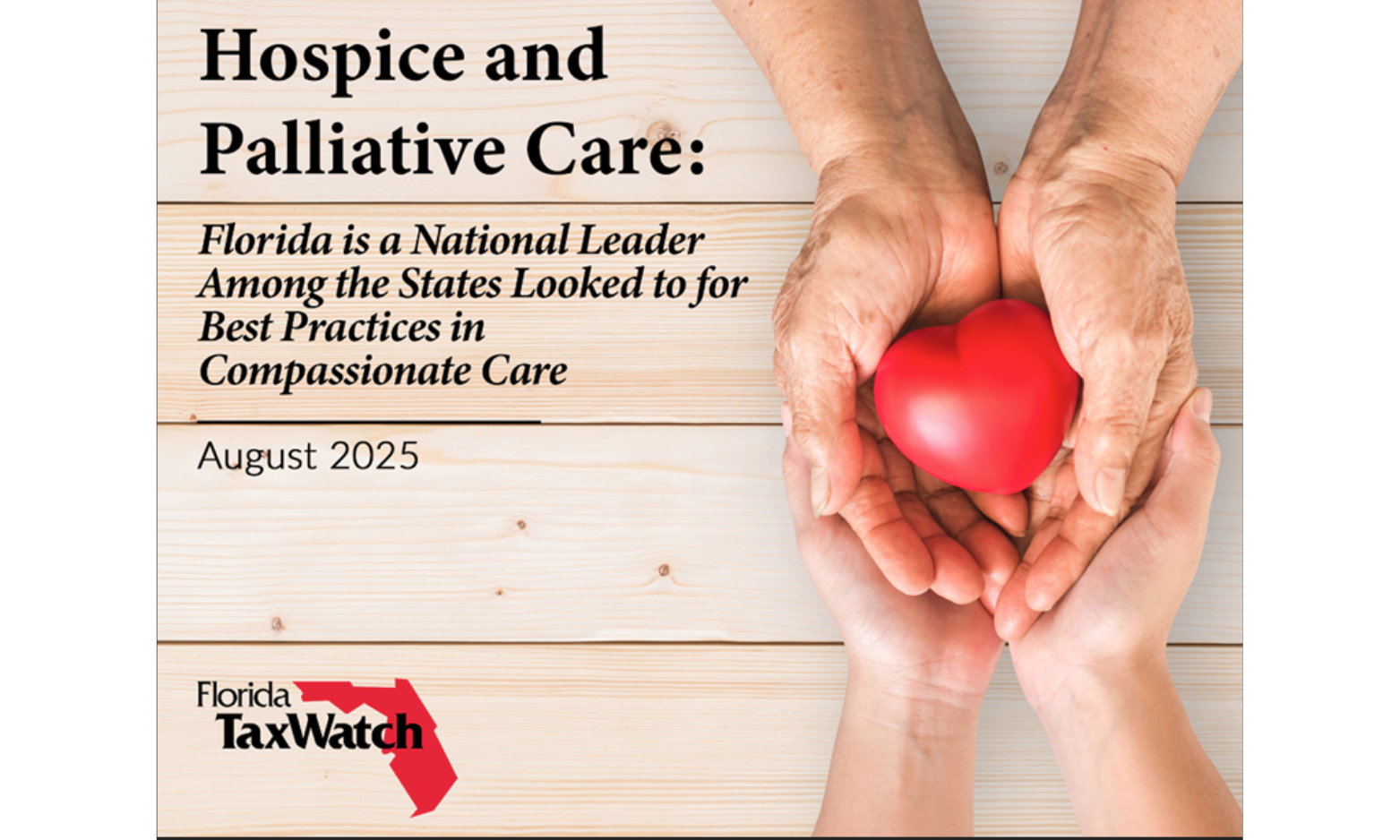
Every year FHPCA asks the Governor’s office to declare November Hospice and Palliative Care Month which he has done for 2025. Thank you Gov. DeSantis for your support of hospice!
Florida TaxWatch, August 7, 2025
Florida’s aging population is driving sustained demand for cost-effective, patient-centered care across the continuum. Palliative care—non-curative, interdisciplinary support for patients with serious but often nonterminal conditions—improves quality of life and can lower overall costs when introduced early in the disease course. Hospice provides end-of-life care once a clinician certifies a terminal prognosis; in Florida, hospice providers operate under a Certificate of Need (CON) program that authorizes new entrants only when unmet need is demonstrated through twice-yearly batching cycles…Read whole article here
Read the Florida TaxWatch study here
TALLAHASSEE, Fla., November 3, 2020 – Governor Ron DeSantis has declared November as Hospice and Palliative Care Month in Florida. 139,865 patients received hospice care throughout Florida in 2019, and a continual increase is expected in the years ahead. Florida Hospice & Palliative Care Association is pleased to join hospice providers and supporters across the state in recognizing November as Hospice and Palliative Care Month in Florida. High quality care, education, and accessibility are hallmarks of hospice care in Florida as every eligible resident has a hospice services available to them. Hospice and Palliative Care Month in Florida highlights the quality and variety of services offered in every county across the state.
“The beliefs that, ‘Every day is a gift’ and ‘The days you have should be lived to the fullest’ are foundational to the valuable services available through your local hospice,” said Paul A. Ledford, President & CEO of Florida Hospice & Palliative Care Association. “When curative therapies are no longer helpful, it is appropriate for the plan of care to change focus to be about comfort and quality of life. This November, we want to raise awareness that hospices around Florida are here to help. It is very rewarding to see patients and families find the comfort and care they need, at the right place, and the right time.”
Read Governor DeSantis’ proclamation at http://bit.ly/2020FLHPM
Visit www.LetHospiceHelp.org to find basic facts and resources on what to expect from hospice providers as a patient and caregiver. The ‘Find a Provider’ feature allows users to locate end-of-life care programs in Florida.
Today, FHPCA’s House Bill 539- “An Act Relating to Hospices” passed the Florida House Health Innovation Subcommittee. This bill addresses quality measures, prescription drug disposal after a patient’s death, and palliative care services to non-hospice, seriously ill patients.
Here’s the moment the bill passed:
Learn more information about FHPCA’s 2017 Legislative Advocacy (HERE)
Charles Suggs lII, MD Medical Director of Gulfside Hospice & Pasco Palliative Care
So you have heard about palliative care, but are unsure of what it is. Palliative care (pronounced pal-lee-uh-tiv) is specialized medical care for people with serious and chronic illnesses. It focuses on providing patients with relief from the symptoms, pain, and stress of a serious illness—whatever the diagnosis. The goal is to improve quality of life for both the patient and the family.
Palliative care is provided by a team of doctors, nurses and other specialists who work together with a patient’s other doctors to provide an extra layer of support. It is appropriate at any age and at any stage in a serious illness. Plus, it can be provided along with curative treatment.
If you are considering looking into palliative care but need to know more, below is some information that can help you to decide if palliative care is right for you. There are many benefits of palliative care (comfort care) for both patients and their families.

Pain and symptom control: The palliative care team identifies sources of pain and discomfort. These may include problems with breathing, fatigue, depression, bowel/bladder or insomnia. The team will provide treatments that can offer relief, including medication, along with massage therapy or relaxation techniques.
Communication and coordination: Palliative care teams are extremely good communicators. They put great importance on communication between you, your family and your doctors in order to ensure that your needs are fully met. These include establishing goals for your care, help with decision-making and coordination of care. Palliative care teams also can help families develop advance care plans, including healthcare directives.
Emotional support: Palliative care focuses on the entire person, not just the illness. The team members caring for you will address any social, psychological, emotional or spiritual needs. During the initial consult, the palliative care team member goalis improve patient satisfaction.
Family/caregiver support: Caregivers bear a great deal of stress too, so the palliative care team supports them as well. This focused attention helps ease some of the strain and can help you with your decision-making.
How do I know if palliative care is right for me? Palliative care may be right for you if you are experiencing pain, stress and other symptoms due to a serious illness. Serious illnesses include but are not limited to: cancer, cardiac disease, respiratory disease, kidney failure, Alzheimer’s, AIDS, amyotrophic lateral sclerosis (ALS) and multiple sclerosis. Palliative care is appropriate at any stage of a serious illness and you can get it along with treatment meant to cure you.
Other signs that palliative care may be helpful for you include: frequent ER visits or hospital admissions for the same condition, functional or cognitive decline, weight loss, increased safety and behavioral concerns, caregiver stress, chronic home oxygen use or limited social and home resources and service support.
Will my insurance cover palliative care? Most insurance plans cover all or part of the palliative care treatment you receive, just as with other hospital and medical services. This is also true of Medicare and Medicaid. If costs concern you, a social worker or financial consultant from the palliative care team can help you with payment options.
Do I have to give up my own doctor? The palliative care team provides an extra layer of support and works in partnership with your primary doctor. Your primary doctor will continue to direct your care and play an active role in your treatment.
Can I have curative treatment together with palliative care? Absolutely. Your treatment choices are up to you. You can get palliative care at the same time as treatment meant to cure you.
Where is palliative care provided? Palliative care can be provided in a number of places. These include hospitals, outpatient clinics, long-term-care facilities or home.

By Ana Sanchez, M.D., Community Hospice of Northeast Florida
When it’s hard to breathe, it’s difficult to think of anything else.
Floridians who live with Chronic Obstructive Pulmonary Disease, or COPD, may know that all too well, especially this time of year.
As temperatures across our state take a momentary wintery dip, COPD’s signature symptoms—shortness of breath, coughing and wheezing induced by emphysema or chronic bronchitis—will flare up for some in proportion to the chill. Likewise, our steamy, humid summers also can prove dangerous for those who live with this incurable disease. These symptom manifestations will be unique to each person.
How many Floridians ride this climatological roller coaster?
The Centers for Disease Control and Prevention’s Behavior Risk Surveillance Survey pegs Florida’s COPD prevalence rate at 7.1 percent1. That’s nearly 1.4 million Floridians whose daily activities, relationships and emotions are impacted by this chronic condition, America’s third leading cause of death, with symptoms that can endure for years or decades.
When do these individuals catch a break, or in this context, a breath?
As a hospice physician, it is my goal to affect the best life possible for the patients and families I serve. While there are people living with COPD whose symptoms will qualify them for a hospice admission, quality of life can be a challenge well before then, too, starting at initial diagnosis. You may encounter these individuals regularly, as patients, clients or even caregivers to others.
How can we help them live better?
Customized medication regimens and action plans coordinated by a medical professional are the first steps to reducing exacerbations and restoring clear breathing. Bronchodilators, anti-inflammatories, combination medications, antibiotics and vaccines may lessen symptoms and help avoid infections such as the flu or pneumonia. Because of the complexity of these custom regimens, elders’ caregivers should be well versed in medication management.
Some COPD patients also may benefit from supplemental oxygen, an adjunct therapy that can help people experience a wider range of recreational activities by improving their mobility. Available through a physician’s prescription, today’s oxygen delivery technology makes getting around a much easier proposition, through the use of lightweight, portable concentrators.
Pulmonary rehabilitation, clinical trials and surgical interventions also can be viable options for patients who qualify for them.
Another intervention that can help is palliative care. This medical specialty helps relieve the symptoms, pain and stress of a serious, chronic illness. It also gives patients and caregivers the opportunity to better understand their condition, complete advance care plans, and develop a road map for future care decisions. While hospice is a specific type of palliative care reserved for people who have a time-limited life expectancy, as some COPD patients surely will, palliative care is appropriate at any stage following diagnosis. Hospitals and hospice providers frequently offer these services, for which Medicare, Medicaid and private insurance may cover some costs.
Hospice care may be an option to relieve pain and restore comfort when the disease reaches end-stage status, at a life expectancy of 12 months or less. Some hospice providers have developed unique clinical protocols for COPD, with dedicated respiratory therapists and comfort kits containing key medications to reduce exacerbations and bring quick symptom relief.
Still other hospice providers, including several in Florida, are participating in a five-year Centers for Medicare & Medicaid Services Innovation Center research effort that launched in January, the Medicare Care Choices Model (MCCM). For Medicare beneficiaries who meet CMS criteria, including hospice eligibility, the MCCM offers hospice-like supportive care to patients concurrently with curative therapies as coordinated by their primary care providers. COPD is one of four terminal diagnoses accepted through the model.
As with most chronic illnesses, COPD can drastically affect the lives of those who live with it, and those of their caregivers. Support resources are plentiful, however, and should be tapped to prevent caregiver burnout and create a lifeline to people and institutions that can help. Groups such as the American Lung Association offer telephone help lines, in-person support groups like the Better Breathers Club in area hospitals, and online communities. The National Institutes of Health’s Breathe Better Network members offer COPD public outreach and education, and the Florida COPD Coalition is another resource for provider education events and patient support groups.
And let’s not forget about the root cause of this affliction for so many, cigarette smoking, which is a factor in up to eight out of every 10 COPD-related deaths2. Cessation programs are readily available through employers, houses of worship and online communities.
As health leaders and elder advocates, we all must play a role in helping those in our care live their best lives possible. With education and early intervention, we can make sure our neighbors with COPD breathe easier all year long.
Ana Sanchez, M.D. is chief medical director for hospice services at Community Hospice of Northeast Florida in Jacksonville.
Community Hospice of Northeast Florida strives to improve the quality of life for patients and families, and to be the compassionate guide for end-of-life care in their community. Find out more at http://communityhospice.com.
References:
Mary is in her 70s and has chronic emphysema – but she is not terminal and does not qualify for hospice care. She has been to the ER several times for her illness and her family is concerned about her constant pain. There are thousands of patients that face this type of scenario everyday, if you are among them or know someone who is, below is some information that can help you to decide if palliative care is right for you.
Benefits of Palliative Care
There are many benefits of palliative care (comfort care) for both patients and their families.
After reading about the benefits for palliative care, here are some answers to common questions.
How do I know if palliative care is right for me?
Palliative care may be right for you if you are experiencing pain, stress and other symptoms due to a serious illness. Serious illnesses include but are not limited to: cancer, cardiac disease, respiratory disease, kidney failure, Alzheimer’s, AIDS, amyotrophic lateral sclerosis (ALS) and multiple sclerosis. Palliative care is appropriate at any stage of a serious illness and you can get it along with treatment meant to cure you.
Will my insurance cover palliative care?
Most insurance plans cover all or part of the palliative care treatment you receive, just as with other hospital and medical services. This is also true of Medicare and Medicaid. If costs concern you, a social worker or financial consultant from the palliative care team can help you with payment options.
Do I have to give up my own doctor?
The palliative care team provides an extra layer of support and works in partnership with your primary doctor. Your primary doctor will continue to direct your care and play an active role in your treatment.
Can I have curative treatment together with palliative care?
Absolutely. Your treatment choices are up to you. You can get palliative care at the same time as treatment meant to cure you.
Where is palliative care provided?
Palliative care can be provided in a number of places. These include hospitals, outpatient clinics, long-term-care facilities or home.
For information about palliative care and how it can help your family, contact Florida Hospice & Palliative Care Association to find out organizations offering palliative care services in your area. If you live in Pasco County, Florida – Pasco Palliative Care is available to help you and your loved ones. Please visit http://www.ghppc.org/ for more information.
 Gulfside Hospice & Pasco Palliative Care strives to ensure that every patient is cared for compassionately, comfortably and with dignity, and that every family receives the support they need during this difficult time. Gulfside Hospice is licensed by the state of Florida, is both Medicare and Medicaid certified. Visit www.ghppc.org for more information.