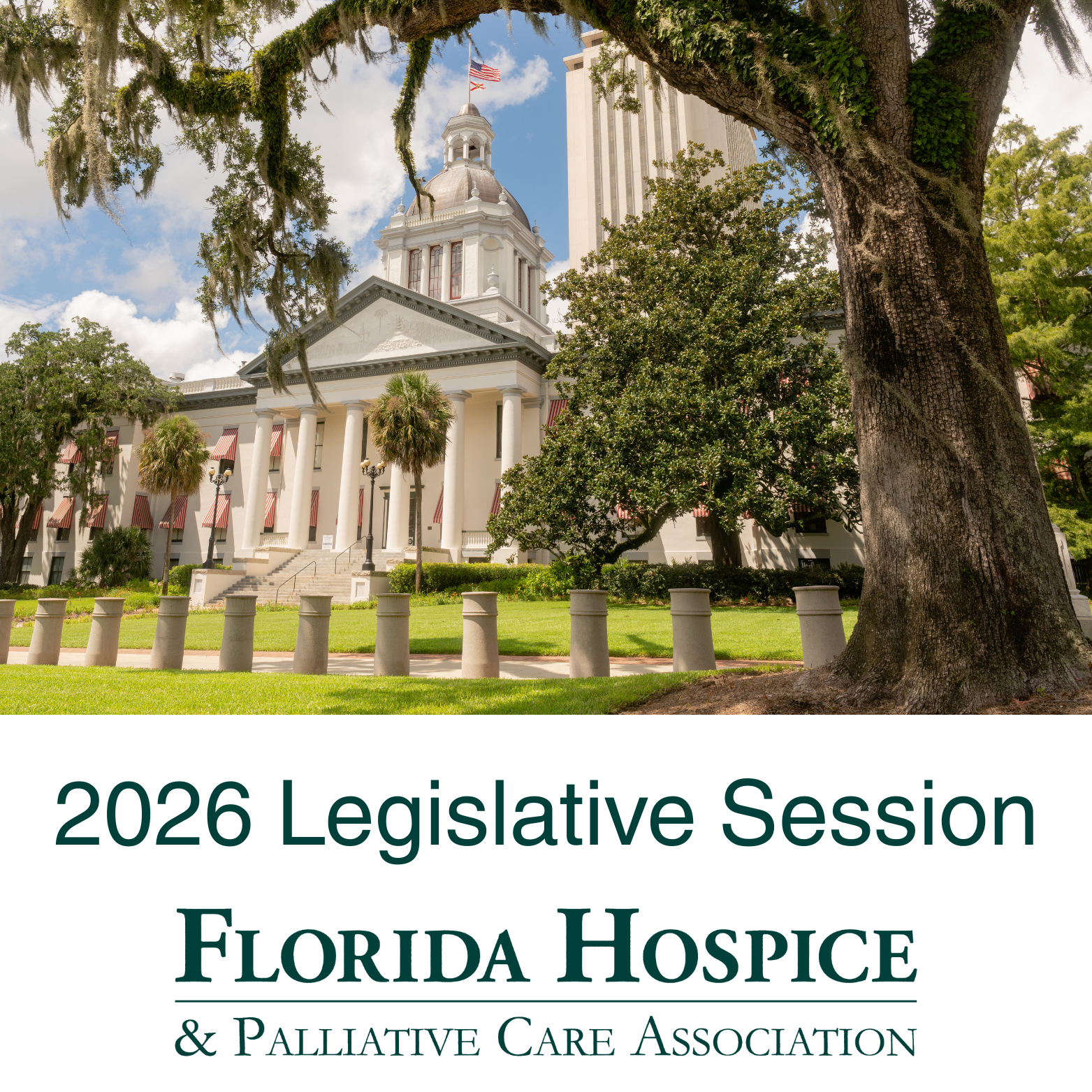
The 2026 Legislative Session (January 13-March 13) has kicked off and is wasting no time getting to work. FHPCA is working diligently to mitigate a portion of House Bill 693 which eliminates Certificate of Need in Hospice and skilled nursing facilities, there is not a Senate version of this bill as of January 13. We are supporting Patient Directed Medical Orders (like POLST/MOLST), have several other issues we are engaged on, and dozens of issues we are closely monitoring.
During the Joint Opening Session on Tuesday, Governor DeSantis delivered his final (8th) State of the State address to the House and Senate, and as would be expected, he recapped his most important accomplishments as Governor. He called upon the Legislature to send meaningful property tax reform legislation to his desk – promising to sign it. Property tax reform is expected to consume much of the 2026 Session bandwidth, with rumblings of a Special Session in April to conduct a mid-decade Congressional redistricting plan.
For context, this is a reminder that Republicans hold super-majorities in the Florida House and Senate and hold every elected statewide office. That is useful information to know as you observe the process.
Stay tuned through session as we represent the hospice and palliative care sectors of health care.
If you are interested in watching the goings-on in Tallahassee, you may tune into the Florida Channel to watch the House and Senate Chambers live, committees at work, and interviews and press conferences as they occur. You will find the calendar and schedule at the links, below, and can find many of those committee meetings and interviews on the Florida Channel.
Every year FHPCA asks the Governor’s office to declare November Hospice and Palliative Care Month which he has done for 2025. Thank you Gov. DeSantis for your support of hospice!
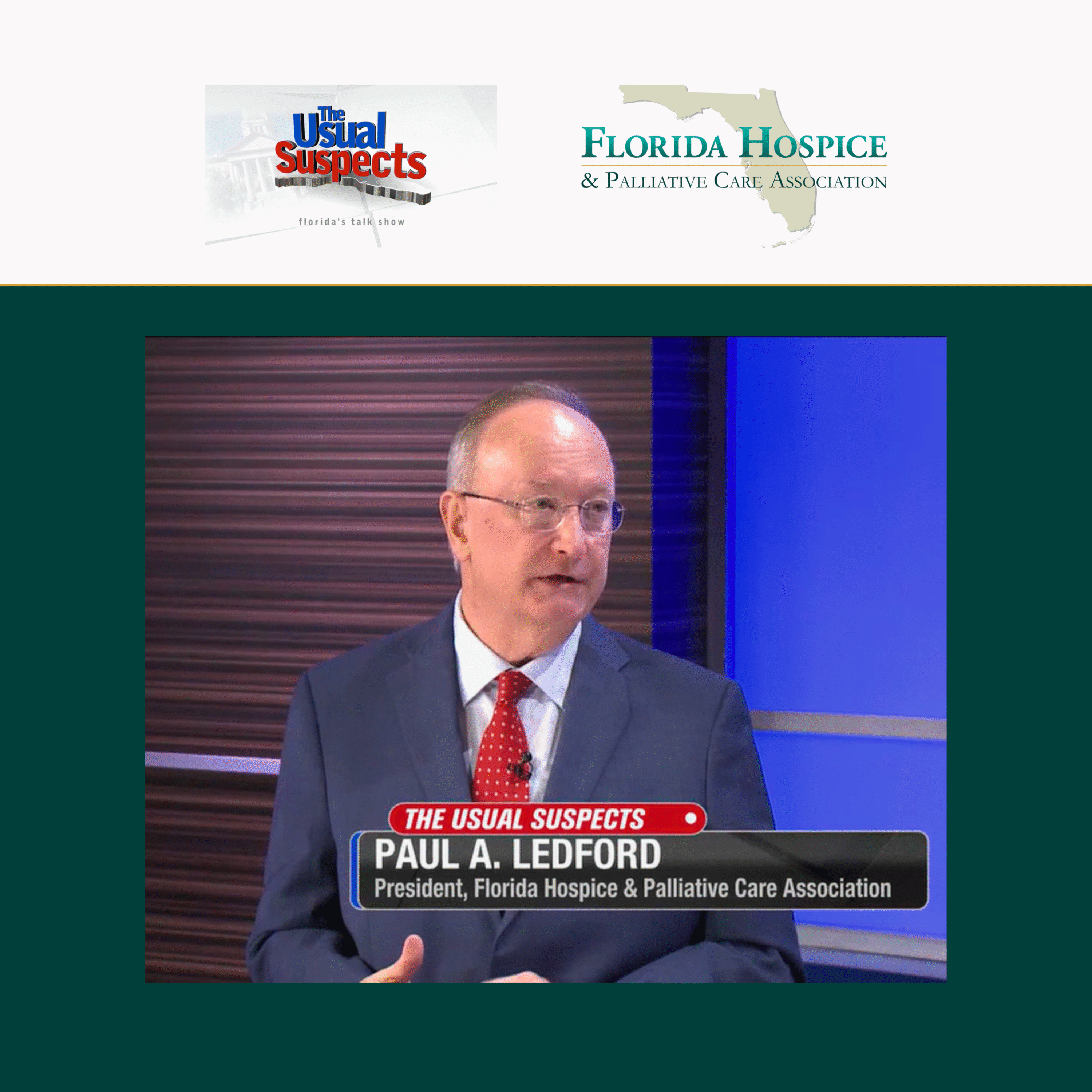
FHPCA President & CEO, Paul Ledford was a guest on The Usual Suspects, a CBS syndicated political talk show, recently. Ledford was interviewed by Steve Vancore, one of the show’s hosts, and President of Vancore Jones Communications. FHPCA is a client of Vancore Jones Communications, so Vancore is very familiar with hospice issues in Florida. There is 22-minutes of dialog if you fast forward through the advertisements. The discussion is primarily a ‘50,000 foot’ discussion about hospice in general, and why Florida’s regulatory system works well.
Watch here: The Usual Suspects – October 26, 2025
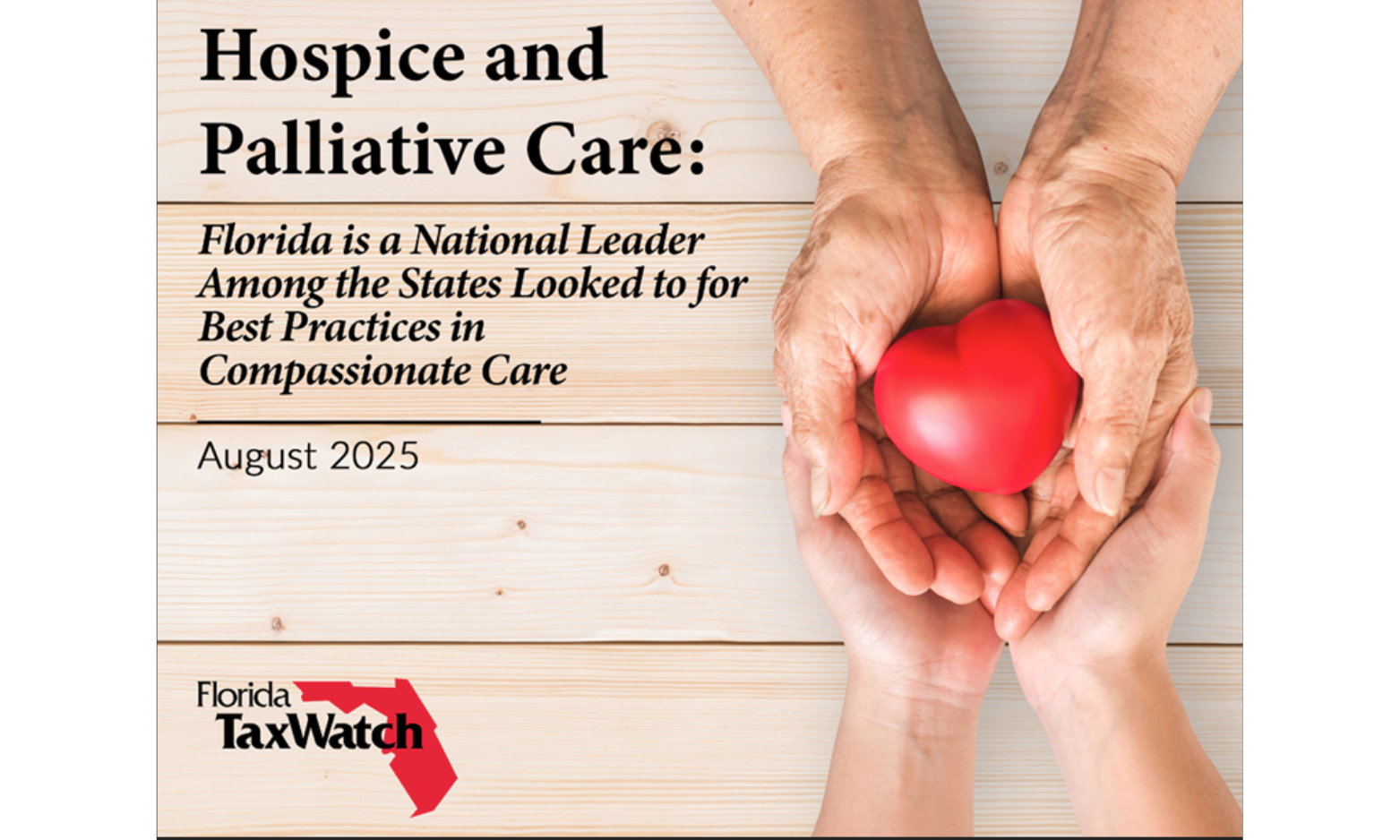
Florida TaxWatch, August 7, 2025
Florida’s aging population is driving sustained demand for cost-effective, patient-centered care across the continuum. Palliative care—non-curative, interdisciplinary support for patients with serious but often nonterminal conditions—improves quality of life and can lower overall costs when introduced early in the disease course. Hospice provides end-of-life care once a clinician certifies a terminal prognosis; in Florida, hospice providers operate under a Certificate of Need (CON) program that authorizes new entrants only when unmet need is demonstrated through twice-yearly batching cycles…Read whole article here
Read the Florida TaxWatch study here
Gov. Ron DeSantis has signed legislation that would take some stress off palliative care physicians who guide patients through their final hours, as well as the grieving families they leave behind.
Sponsored by Republican Rep. Dana Trabulsy, HB 647 would allow Advanced Practice Registered Nurses (APRNs) to complete and file death certificates for hospice care patients.
Click here to read the whole article from Florida Politics!
By Ana Sanchez, M.D., Community Hospice of Northeast Florida
When it’s hard to breathe, it’s difficult to think of anything else.
Floridians who live with Chronic Obstructive Pulmonary Disease, or COPD, may know that all too well, especially this time of year.
As temperatures across our state take a momentary wintery dip, COPD’s signature symptoms—shortness of breath, coughing and wheezing induced by emphysema or chronic bronchitis—will flare up for some in proportion to the chill. Likewise, our steamy, humid summers also can prove dangerous for those who live with this incurable disease. These symptom manifestations will be unique to each person.
How many Floridians ride this climatological roller coaster?
The Centers for Disease Control and Prevention’s Behavior Risk Surveillance Survey pegs Florida’s COPD prevalence rate at 7.1 percent1. That’s nearly 1.4 million Floridians whose daily activities, relationships and emotions are impacted by this chronic condition, America’s third leading cause of death, with symptoms that can endure for years or decades.
When do these individuals catch a break, or in this context, a breath?
As a hospice physician, it is my goal to affect the best life possible for the patients and families I serve. While there are people living with COPD whose symptoms will qualify them for a hospice admission, quality of life can be a challenge well before then, too, starting at initial diagnosis. You may encounter these individuals regularly, as patients, clients or even caregivers to others.
How can we help them live better?
Customized medication regimens and action plans coordinated by a medical professional are the first steps to reducing exacerbations and restoring clear breathing. Bronchodilators, anti-inflammatories, combination medications, antibiotics and vaccines may lessen symptoms and help avoid infections such as the flu or pneumonia. Because of the complexity of these custom regimens, elders’ caregivers should be well versed in medication management.
Some COPD patients also may benefit from supplemental oxygen, an adjunct therapy that can help people experience a wider range of recreational activities by improving their mobility. Available through a physician’s prescription, today’s oxygen delivery technology makes getting around a much easier proposition, through the use of lightweight, portable concentrators.
Pulmonary rehabilitation, clinical trials and surgical interventions also can be viable options for patients who qualify for them.
Another intervention that can help is palliative care. This medical specialty helps relieve the symptoms, pain and stress of a serious, chronic illness. It also gives patients and caregivers the opportunity to better understand their condition, complete advance care plans, and develop a road map for future care decisions. While hospice is a specific type of palliative care reserved for people who have a time-limited life expectancy, as some COPD patients surely will, palliative care is appropriate at any stage following diagnosis. Hospitals and hospice providers frequently offer these services, for which Medicare, Medicaid and private insurance may cover some costs.
Hospice care may be an option to relieve pain and restore comfort when the disease reaches end-stage status, at a life expectancy of 12 months or less. Some hospice providers have developed unique clinical protocols for COPD, with dedicated respiratory therapists and comfort kits containing key medications to reduce exacerbations and bring quick symptom relief.
Still other hospice providers, including several in Florida, are participating in a five-year Centers for Medicare & Medicaid Services Innovation Center research effort that launched in January, the Medicare Care Choices Model (MCCM). For Medicare beneficiaries who meet CMS criteria, including hospice eligibility, the MCCM offers hospice-like supportive care to patients concurrently with curative therapies as coordinated by their primary care providers. COPD is one of four terminal diagnoses accepted through the model.
As with most chronic illnesses, COPD can drastically affect the lives of those who live with it, and those of their caregivers. Support resources are plentiful, however, and should be tapped to prevent caregiver burnout and create a lifeline to people and institutions that can help. Groups such as the American Lung Association offer telephone help lines, in-person support groups like the Better Breathers Club in area hospitals, and online communities. The National Institutes of Health’s Breathe Better Network members offer COPD public outreach and education, and the Florida COPD Coalition is another resource for provider education events and patient support groups.
And let’s not forget about the root cause of this affliction for so many, cigarette smoking, which is a factor in up to eight out of every 10 COPD-related deaths2. Cessation programs are readily available through employers, houses of worship and online communities.
As health leaders and elder advocates, we all must play a role in helping those in our care live their best lives possible. With education and early intervention, we can make sure our neighbors with COPD breathe easier all year long.
Ana Sanchez, M.D. is chief medical director for hospice services at Community Hospice of Northeast Florida in Jacksonville.
Community Hospice of Northeast Florida strives to improve the quality of life for patients and families, and to be the compassionate guide for end-of-life care in their community. Find out more at http://communityhospice.com.
References:


It’s that time again! Time to select those outstanding hospice professionals you would like to see nominated for the “Awards of Excellence“. For those who might not know, these awards are a unique opportunity for outstanding individuals to get statewide recognition for consistent dedication to teamwork, innovation and more in hospice. It’s a celebration of excellence for the delivery of hospice and palliative care. You are free to make more than one nomination for those you feel compelled to, in fact we encourage it. The awards are open to employees or volunteers who are members of FHPCA and in the Florida hospice community.
Nominations are judged by a selection committee composed of leaders within the hospice industry. The selection committee is looking for examples and specific details that demonstrate how nominees have exceeded expectations and, by their actions, made those around them better. Nominees must be an FHPCA member in good standing at the time of nomination and at the time of the award presentation.
Individual Awards
 This award recognizes an individual in any role within an organization who has consistently demonstrated leadership in forging the collaboration that makes hospice unique. This individual seeks excellence not only in his/her field, but also in cooperation with other disciplines. He/she fosters collaboration and brings teams together to the betterment of his/her organization. This award celebrates the spirit of collaboration within a hospice organization. As hospice is the sum of many parts working together to care for patients and families, this award honors individuals who lead across disciplines and foster teamwork within their sphere of influence.For more information on nomination rules and requirements, click HERE.
Program Awards
 Is the Award of Excellence to the group that makes collaboration happen. This award recognizes a group of people in any role or configuration that has consistently demonstrated the ideals of collaboration and teamwork in working toward a goal or mission. This group not only seeks excellence within itself, but also inspires excellence and collaboration throughout the hospice environment. As hospice is the sum of many parts working together to care for patients and families, this award champions the spirit of teamwork and honors teams who make hospice work better and more effectively. For more information on nomination rules and requirements, click HERE.
 The Breakthrough Award recognizes an individual or team who, through their efforts to research and implement new ideas, has improved hospice care. Whether piloting a new program, streamlining a process or discovering a better way to provide a service, the recipient of this award advances the mission of hospice and provides a path for others to follow. For more information on nomination rules and requirements, click HERE.
Each of the 2016 award winners will receive a cash prize in addition to a recognition plaque. The winning individuals and programs will be celebrated by their peers from around the state at the annual Awards of Excellence luncheon held on June 2nd in conjunction with FHPCA’s non-clinical conference, Hospice Works. Winners will also be featured state-wide in FHPCA’s newsletter, website, and social media outlets, as well as a press release sent to media professionals across the state.
This is a quick an easy process. Press the nomination below to get started! We encourage you not to stop at one nomination, especially if you feel that multiple people have achieved excellence in the above categories. There are a few nomination submission requirements so be sure to read carefully through those and follow the instructions.

When Is the Ceremony?
The ceremony to be held Thursday, June 2nd at the Renaissance Orlando at SeaWorld in conjunction with FHPCA’s Hospice Works Forum.
What Is the Deadline to Submit Nominations?
Deadline to submit entries is MONDAY, MARCH 21st.
For more information, visit our Forum Annual Conference Website.
Attendees at our 2015 clinical conference, “Painting the Picture: Messaging Metrics & Mission,” had a unique opportunity to witness artists such as poets, dancers, and painters perform their crafts during the “The Art of Grief” Live Art Showcase. One of those artists was a painter name Jacob J. Neagle, who with his canvas, oil paints, and easel painted a stunning piece of art in front of the live audience.

After the showcase ended, Neagle’s painting was revealed at the Cocktail Social Hour, held directly after the event.

The finished painting, titled Brother At Rest, was of a large tree, in a beautiful field full of grass and a young man in the middle. Neagle recounted that his inspiration behind the painting was his brother Joshua, who last October at the age of 29, passed from brain cancer. In his final weeks, Neagle was able to live beside his brother and experience firsthand the compassion and care of hospice.

Not wanting to keep this inspiring piece of art to ourselves, we began an Art Roadshow and sent Brother At Rest on a road trip to hospice providers around the state. Hospices hosting the art will display the painting in various places such as their administrative office, inpatient or residential unit. Art is powerful and motivates us to look deep inside ourselves. We hope that Brother At Rest helps hospice providers connect to the tremendous work they do everyday.
Where is it Now?
Treasure Coast Hospice kicked off the Art Roadshow by housing the painting in their facility. Now, Brother At Rest has made its way to Hospice of St. Francis where it will stay for two weeks.

Treasure Coast Hospice staff holding Brother At Rest

By Avow
It was a beautiful day in May when Jessica received the call informing her that her father had succumbed to a fatal heart attack. “Dad” was 77 and apparently suffering from undetected heart disease. The loss came as a surprise to Jessica along with the discovery that her father had never put his affairs in order – a shocking realization considering “Mom” was suffering from advanced dementia.
With Dad gone, caring for Mom would fall to Jessica, the oldest of the couple’s eight children – a nurse by training and one of two siblings living locally. Jessica promptly moved Mom into her home and was ready to become a supportive caregiver – confident that she could handle it since she worked from home and her two grown children were off at college.
Following her father’s death, however, Jessica found herself wading through what seemed to be an insurmountable mound of red tape required to close her parents’ estate. Dad had no will or funeral plan and had not prepared a living will or power of attorney plan for her mother. Jessica did not even know which bank her parents used. At the same time, Jessica was facing the heartbreaking truth that her mom was steeped in dementia and required 24-hour care and supervision – clearly Dad had provided much more support than he ever let on.
In the years leading up to her father’s death, Jessica brought up the topic of getting affairs in order, but most often, her father would dismiss the topic and say, “I’ll get to it.” He never did of course and now Jessica would need to turn to an attorney for help. The process would be long and exhausting and she would spend thousands of dollars in legal fees. Jessica wished she could have spent these funds on enhanced care for her mother who experienced a rapid deterioration from Alzheimer’s disease and eventually required placement in a nursing facility.
Unfortunately, Jessica’s story is not unique and her father’s avoidance of getting his affairs in order is common. For many of us, the idea of illness or death touching our lives is easily avoided or dismissed for attention later¬. Plus, getting your affairs in order is work and often carries some expense. It also requires some serious decision-making and hard conversations.
If “getting your affairs in order” is still on your to-do list, learn from Jessica’s story and move it up in priority. If you have aging parents, find out what plans they’ve made, if any. Don’t let perceived youth delay your actions – accidents and serious illnesses have no age qualifiers.
Need some help getting started? Avow has some free tools available on its website including:
Both resources are provided in PDF format and may be downloaded at avowcares.org. To go directly to the resource links visit: http://avowcares.org/docs/living-will-resources

Avow delivers the promise of life by providing comfort, care, understanding and dignity to those who are seriously ill, caring for a frail or sick loved one or mourning someone’s passing. They are knitted into their community, providing supportive services to anyone who needs them, including those whose loved ones were not in our programs. Find out more at avowcares.org
Courtesy of HPH Hospice
Picture this: Your mother has broken her arm and it’s time to make her traditional pecan pie for the holidays.
It’s easy to see that it would be difficult for her to make the pie this year, so you let her know that she shouldn’t worry about bringing it.
Bereavement counselor Dale Thien offers practical tips for grieving people who are expecting a difficult holiday season. It’s easy for people to see a broken arm, said Dale Thien, a bereavement counselor for HPH Hospice. It’s not always so easy to see the effects of a heart that’s broken by the death of a loved one.
 The bereavement counselor said she often opens her workshops by talking about how expectations change when we can see a physical ailment that poses limitations, and the need to make similar adjustments when someone has suffered an emotional loss that’s equally, if not more, debilitating.
“Your grief is like you have a broken heart,” Thien said. “The thing is, we can’t really see that.”
During her workshops, she asks those who are grieving to give themselves permission to grieve. And, she asks them to let their loved ones know what they need.
“Understanding can come from the rest of the family, as they adjust their expectations about the holidays and about the role that this grieving person will play,” she said.
The death of a loved one often creates a sense of disorientation and a loss of equilibrium, as people adjust to life without the physical presence of their loved one.
“So, we want to make adjustments,” she said.
It may be time to modify the family routine, Thien said.
“We don’t want to stress people out with too much of the same because it becomes so obvious that there’s a big gaping hole where the person you loved used to be,” the counselor said. “I think some people dance around the issue of, should we mention the loved one’s name or not?”
Typically, people look to the person who had the closest connection to the deceased to provide guidance on this issue, she said.
“If you’re the grieving person and it was your main loss, then probably your family is waiting for you to mention their name,” Thien said. “And then, they will get the go-ahead that it’s OK to be talking about that.”
She recalled an instance when a widow told her that she was angry with her family because they never once mentioned her deceased husband during the holidays. Later, that same day, the daughter told the counselor she was upset because they had not talked about her father.
“So, everyone just danced around this elephant in the living room,” Thien said. “No one acknowledged it.”
People often do not know how to handle these situations, Thien said. She suggests, in this case, the daughter could have said to her mother in private: “I’m interested in talking about dad. Is that OK with you?”
The workshop seeks to give grieving people the tools for handling the holidays.
“We’re also going to try to empower the grieving person to ask for what they need,” she said.
One practical tip is for grieving people to drive themselves to holiday gatherings, Thien said. That way, they’re free to leave when they want to.
People who are grieving may not be up to the hustle and bustle of shopping.
So Thien advises them to simplify their gift giving. They can buy everyone the same gift, for instance, or send mail-order baskets of fruit. Or, they can give cash.
People who are grieving may not feel like sending out holiday cards. They might not have the energy to decorate the house.
They don’t have to, Thien said. “You get a pass this year.”
Or, they may want to invite family members to come decorate their home, or just put up fewer decorations.
If they decide to attend holiday gatherings, she said, they might need to step aside if they’re having trouble handling their emotions.
It’s perfectly fine to tell a party host: “I’m doing as well as I can, being here, around all of this merriment at holidays, but please understand that this is hard for me. So, if I need to go outside for a minute and have a tear, please don’t follow me. Please just let me be, and I’ll come back into the room when I’m ready.”
People grieve in different ways.
“Some people clearly do want to be left alone,” Thien said. “It’s certainly OK to opt out entirely.”
On the other hand, she added, some people “need hugs and socialization and reassurance.”
“My suggestion is small doses,” Thien said.
Swing by holiday parties, but just stay as long as you feel comfortable.
“You’re doing the important work of adjusting to life, now that your loved one is gone,” she said. “You are engaging in trying to find a new normal for yourself.”
The bottom line is finding what works for you during the holiday season, she said.
“People who really love you are going to understand,” Thien said.
 HPH Hospice (HPH) is a not-for-profit community-based healthcare organization providing innovative, skilled medical care to patients with life-limiting illness and compassionate support to their family members.
Established in 1982, and initially licensed in 1984, we provide hospice care to the residents of Pasco, Hernando and Citrus counties in Florida. Our commitment to the individualized needs of our patients, and our focus on Care, Comfort and Support in delivering compassion and dignity, have remained our strength.
November is Hospice & Palliative Care Month (read Governor Scott’s proclamation) and a great time to learn more about the wonderful services hospice and palliative care provides patients and families.
What is hospice and palliative care?  Hospice and palliative care regards dying as a natural process. The goal of hospice and palliative care is to achieve the best possible quality of life through coordinating and/or managing the Plan of Care with goals to: relieve suffering, and control symptoms, and while remaining sensitive to personal, cultural and religious values, beliefs and practices.
Four take aways about hospice and palliative care:
How can you support hospice and palliative care in Florida?
There are numerous ways you can support the mission and services of hospice and palliative care. You could volunteer at a hospice program, donate to a program in your area, donate to FHPCA, or purchase the Hospice Specialty License Plate.
About the Specialty Hospice License Plate:
When you purchase a license plate, $25 a year goes a long way by providing support towards the following:
Florida Hospice & Palliative Care Association (FHPCA) is a not-for-profit, IRS Section 501(c)(3) organization representing hospice patients and families, hospice professionals and hospice providers. FHPCA strives to assure excellence in, and expand access to, hospice and palliative care, and advocates for the needs of those in the final stages of life. One of the ways we are able to accomplish our mission is through the sales of the Specialty Hospice License Plate. Visit HERE for more information or to purchase your plate.
Medicare has announced significant changes in the hospice drug coverage rules, prompting cheers from many patient advocates within and beyond the hospice community. Many feared that the original changes would have had disastrous effects on quality of care by limiting the ability of terminally ill patients to gain access to medication that is crucial to both comfort and functionality at the end of life.
The newly announced modification to the Medicare Part D rules change applies to coverage for drugs unrelated to terminal illness; for example, a hospice patient with terminal cancer who also takes medication for his arthritis. “The new policy should eliminate 95% of the cases in which hospice patients need prior approval from an insurance company to get coverage for their drugs, according to participants in a Medicare briefing.”
The original new policy, which came into effect in May of this year, required patients to receive prior approval from their Medicare Part D insurer before they could fill a prescription for medications not specifically related to their terminal illness. “This became a tedious process, and many prescriptions went unfilled, because it took a long time to get prior approval and the families might not be able to afford the drugs without insurance coverage.”
The new changes to Medicare Part D only require prior approval for four specific classes of drugs: Analgesics, antinauseants, laxatives, and anti-anxiety drugs. In a policy statement issued by CMS, the federal agency noted that these drugs are “nearly always covered under the hospice benefit.” Because CMS estimates that there will be very few Part D claims for drugs in these categories, “barriers to beneficiary access should be minimized.”
The National Hospice and Palliative Care Organization welcomed the CMS announcement of changes saying that it as a measure that will “reduce confusion for hospice providers and… allow patients to get their medications when they need them.” J. Donald Schumacher, NHPCO president and CEO noted, “With this change, patients and their families will no longer be caught in the middle of troublesome policy and stakeholders can implement an interim solution that can more easily be understood by all providers.”
Related Articles:
By Wendy Melton Abbott, Team Leader, Big Bend Hospice
As a hospice nurse, I often find that when families learn all that hospice care has to offer, they are both relieved and concerned: relieved that the comprehensive list of services aims to comfort their loved one and assists them as the caregiver; concerned about how such valuable services are paid for. Many times people are hesitant to contact hospice because they are unsure of the cost.
They are comforted when they learn once someone is medically qualified for hospice most hospice patients are covered through Medicare, Medicaid or private insurance. Often, hospice programs in Florida are also able to offer services to anyone regardless of ability to pay thanks to community support.
Medicare Part A provides coverage for hospice services to people over the age of 65, including expert pain and symptom management, medicines, medical equipment and supplies related to the hospice diagnosis. Specifically, it covers physician and nursing services, hospice aides, spiritual, continuous care during crisis periods, trained volunteers and bereavement services.
The hospice benefit does not require patients to be homebound. Hospice patients are free to go out to visit friends and family, or participate in other activities as they are able. A patient can remain in hospice care beyond six months if a physician re-certifies that the patient is terminally ill. Regular Medicare coverage is available to Hospice beneficiaries for non-terminal related services. Keep in mind that the hospice benefit does not pay for round-the-clock care for patients; however, sometimes hospice social workers may be able to help figure out how to get additional care.
Florida also offers Medicaid hospice coverage, which is patterned after the Medicare hospice benefit. Coverage by private insurance is similar to the Medicare and Medicaid Hospice benefits. Hospice services are covered for military families under Tricare.
Sometimes a terminally ill patient’s health improves or their illness goes into remission and the patient can be discharged from service. Also, as a hospice patient, you always have the right to stop getting hospice care, for any reason. If you stop your hospice care, you will receive the type of Medicare or Medicaid coverage that you had before electing hospice. If you are eligible, you can go back to hospice care at any time.
Contact your local hospice with questions you may have regarding coverage or expenses. You can find a listing of providers in your area by visiting www.floridahospices.org/find-a-hospice.
 Wendy Melton Abbott is the Team Leader for the Gadsden/Liberty County of Big Bend Hospice. Big Bend Hospice has been serving this community since 1983 with compassionate end of life care along with grief and loss counselors available to provide information and support to anyone in Leon, Jefferson, Taylor, Madison, Gadsden, Liberty, Franklin or Wakulla County. If you would like additional information about services, please call 850-878-5310 or visit www.bigbendhospice.org